Halo Labs
MOTS-c (10mg)
MOTS-c (10mg)
Couldn't load pickup availability
# MOTS-c - Mitochondrial-Derived Peptide Research Compound
## SCIENTIFIC OVERVIEW
MOTS-c is a 16-amino acid mitochondrial-derived peptide (MDP) encoded by the mitochondrial 12S rRNA gene. Discovered in 2015, this peptide represents a novel class of signaling molecules that regulate metabolic homeostasis, insulin sensitivity, mitochondrial function, and cellular stress responses. MOTS-c is a key research tool for studying mitochondrial-nuclear communication.
## RESEARCH APPLICATIONS
Scientific investigations have explored MOTS-c for:
- Mitochondrial biogenesis and function research
- AMPK pathway activation studies
- Insulin sensitivity and glucose metabolism research
- Metabolic syndrome and diabetes models
- Exercise response and physical performance studies
- Aging and longevity mechanism research
- Mitochondrial-nuclear retrograde signaling
- Skeletal muscle metabolism analysis
- Mitochondrial stress response pathways (mitohormesis)
- Folate/one-carbon metabolism research
- Cardiovascular function and endothelial health studies
## PRODUCT SPECIFICATIONS
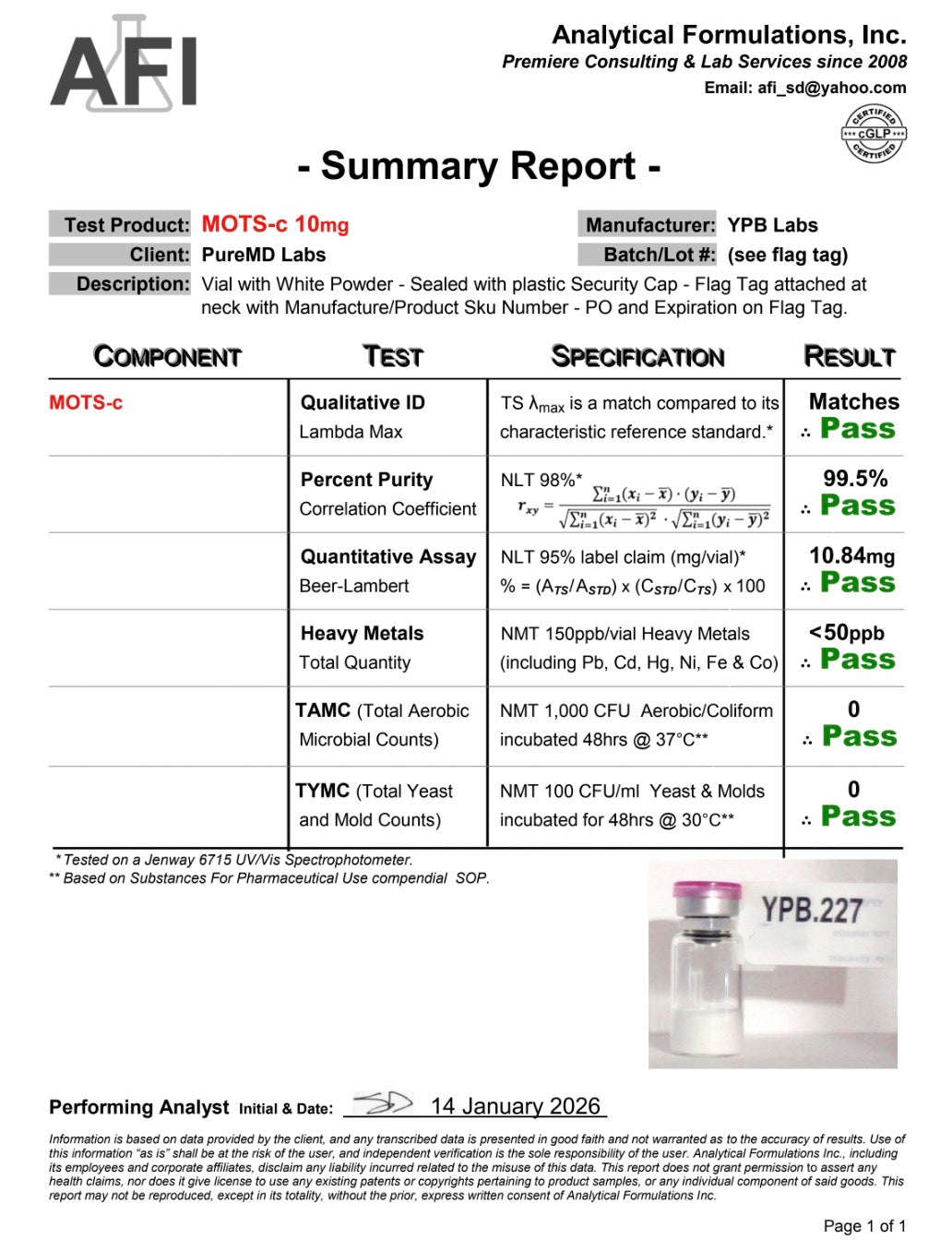
- **Purity:** ≥98% (HPLC Verified)
- **Form:** Lyophilized White Powder
- **Sequence:** Met-Arg-Trp-Gln-Glu-Met-Gly-Tyr-Ile-Phe-Tyr-Pro-Arg-Lys-Leu-Arg
- **Molecular Formula:** C₁₀₁H₁₅₂N₂₈O₂₂S₂
- **Molecular Weight:** 2,174.6 Da
- **CAS Number:** 1627580-64-6
- **Appearance:** White sterile lyophilized powder
- **Solubility:** Water-soluble
- **Storage:** -20°C (freezer), protected from light
- **Shelf Life:** 24 months frozen; 30 days reconstituted at 2-8°C
## QUALITY VERIFICATION
✓ RP-HPLC purity ≥98%
✓ Mass spectrometry confirmation (ESI-MS or MALDI-TOF)
✓ Amino acid composition analysis
✓ Peptide content assay (≥85%)
✓ Endotoxin: <1.0 EU/mg (LAL test)
✓ Sterility testing (USP <71>)
✓ pH: 6.0-8.0 (reconstituted)
✓ Moisture content: <5%
## MECHANISM OF ACTION (Research Context)
MOTS-c represents a paradigm shift in mitochondrial biology—mitochondria as signaling organelles:
**AMPK Activation:**
- Activates AMP-activated protein kinase (master metabolic regulator)
- Increases cellular energy expenditure
- Enhances fatty acid oxidation
- Improves glucose uptake
**Metabolic Regulation:**
- Improves insulin sensitivity in muscle and adipose tissue
- Enhances glucose metabolism via GLUT4 translocation
- Regulates folate/methionine metabolism
- Affects one-carbon metabolism pathways
**Mitochondrial Function:**
- Enhances mitochondrial respiration efficiency
- Increases mitochondrial biogenesis markers
- Improves oxidative phosphorylation
- Reduces mitochondrial ROS production
**Nuclear Translocation:**
- Under metabolic stress, MOTS-c translocates to nucleus
- Binds to DNA and regulates gene expression
- Modulates antioxidant response element (ARE) genes
- Influences cellular stress adaptation
**Exercise Mimetic Properties:**
- Mimics some molecular effects of exercise
- Enhances physical performance in animal models
- Improves skeletal muscle function
- Supports metabolic flexibility
## SCIENTIFIC DISCOVERY
- **2015:** First identified by Pinchas Cohen lab (USC)
- **2016-2018:** Metabolic and exercise effects characterized
- **2019-2020:** Nuclear translocation and stress response discovered
- **2021+:** Ongoing research in aging, longevity, metabolic disease
Over 50 peer-reviewed publications in top-tier journals (Cell Metabolism, Nature Communications, etc.)
## RESEARCH MODELS
MOTS-c has been studied in:
- **Obesity models:** High-fat diet-induced obesity (mice)
- **Diabetes models:** Insulin resistance, glucose intolerance
- **Exercise studies:** Forced swimming, treadmill running
- **Aging research:** Young vs. aged animal comparisons
- **Cell culture:** C2C12 myoblasts, 3T3-L1 adipocytes, hepatocytes
- **Cardiac function:** Ischemia-reperfusion, heart failure models
## RECONSTITUTION PROTOCOL
1. Allow vial to reach room temperature (prevent condensation)
2. Use bacteriostatic water or sterile saline
3. Typical concentration: 0.5-2.0 mg/mL for research
4. Add diluent slowly down the vial wall
5. Swirl gently in circular motion (avoid shaking)
6. Allow 3-5 minutes for complete dissolution
7. Solution should be clear and colorless
8. pH should be approximately 6-8
## STABILITY DATA
- **Lyophilized powder:** 24+ months at -20°C
- **Room temperature (sealed):** 30-60 days
- **Reconstituted:** 30 days at 2-8°C with bacteriostatic water
- **pH stability:** Most stable pH 6-8
- **Freeze-thaw:** Minimize cycles; aliquot for single use
## RESEARCH DOSING CONTEXT
Published literature reports (animal models):
- **Mice (IP):** 5-15 mg/kg, 3-5x per week
- **Mice (daily):** 0.5-5 mg/kg
- **Duration:** 2 weeks to 4+ months in published studies
- **Cell culture:** 5-50 μM typical concentrations
Consult specific publications for detailed protocols based on research objectives.
## COMPARATIVE MITOCHONDRIAL PEPTIDES
**vs. Humanin:** Different mitochondrial ORF, distinct functions (Humanin more cytoprotective, MOTS-c more metabolic)
**vs. SHLP peptides:** Related MDPs from same mitochondrial region, different sequences and functions
**vs. SS-31 (Elamipretide):** Synthetic mitochondrial-targeted peptide, different mechanism
**vs. Metformin/AICAR:** MOTS-c activates AMPK but through distinct pathway
## METABOLIC RESEARCH HIGHLIGHTS
Key findings from published studies:
- Reverses diet-induced insulin resistance (mice)
- Improves glucose tolerance and insulin sensitivity
- Enhances physical performance (endurance running)
- Regulates skeletal muscle metabolism
- Age-dependent decline in humans (correlates with metabolic health)
- Plasma levels decrease with age and obesity
## NUCLEAR FUNCTION DISCOVERY
Groundbreaking 2019 research revealed:
- MOTS-c translocates to nucleus under glucose restriction
- Contains nuclear localization signal (NLS)
- Binds to DNA (AT-rich regions)
- Regulates antioxidant and stress response genes
- Dual cytoplasmetic AND nuclear functions
## HUMAN TRANSLATIONAL RESEARCH
Limited but growing human studies:
- Plasma MOTS-c levels measured in various populations
- Correlations with age, metabolic health, exercise
- Genetic variants in MOTS-c sequence associated with longevity (Japanese centenarians)
- Clinical trials exploring therapeutic potential (ongoing)
## HANDLING & STORAGE
- Store powder at -20°C in original sealed vial
- Protect from light (use amber vials or foil wrap)
- Use sterile technique during all handling
- Work in biosafety cabinet or clean environment
- Wear appropriate PPE (gloves, lab coat, eye protection)
- Aliquot reconstituted solutions to avoid freeze-thaw
- Dispose according to institutional peptide waste protocols
## ANALYTICAL METHODS
For research quantification:
- **HPLC:** RP-HPLC with UV detection
- **ELISA:** Commercial MOTS-c ELISA kits available
- **Western blot:** With specific antibodies
- **LC-MS/MS:** For biological sample analysis
## REGULATORY STATUS
Not FDA-approved for human use. Not registered as pharmaceutical in any jurisdiction. Research chemical for laboratory investigation only. Not a dietary supplement or anti-aging product.
## FOR RESEARCH PURPOSES ONLY
This product is intended strictly for in-vitro research and laboratory animal studies. Not for human consumption or clinical use. Not a supplement, pharmaceutical, or longevity product. Requires institutional oversight and appropriate animal research approvals.
---
**DISCLAIMER:** By purchasing, you certify you are a qualified researcher conducting legitimate scientific investigation in mitochondrial biology, metabolism, or related fields. Purchaser assumes all responsibility for compliance with institutional biosafety protocols, animal research ethics requirements, and applicable laws and regulations.
Share